 Rocket City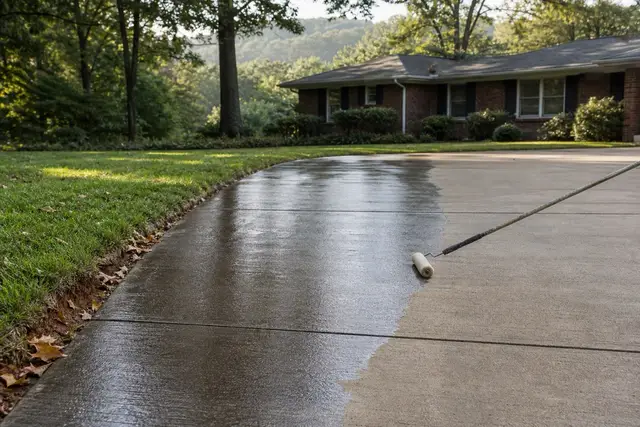
Rocket City Driveways connects Huntsville homeowners with a local concrete contractor for driveway sealing & maintenance in Huntsville and the surrounding Madison County communities.
Here is the physics working against every Huntsville driveway: concrete is porous, the sky delivers about 54 inches of water a year, and from December into March that absorbed water freezes on cold nights and expands inside the slab. Enough cycles and the surface starts flaking off in sheets. A sealer closes the pores so the water sheds instead of soaking in — which is why sealing matters here in a way it simply doesn't on the Gulf Coast.
Product choice follows the driveway. Penetrating sealers soak in and block moisture without changing how the concrete looks — the workhorse pick for plain broom-finished drives. Film-forming acrylics add gloss and richer color, and they're the standard maintenance coat over stamped and exposed-aggregate finishes. New concrete gets its first application only after curing is complete; after that, resealing every few years keeps the protection ahead of the weather.
A maintenance visit is also a checkup. Joint sealant that has split or pulled away gets renewed, red-clay and rust staining gets treated with the right chemistry instead of brute-force pressure washing, and small edge chips or early settlement get flagged while they are still cheap problems. The fall window, before the first hard freezes arrive, is the smart time to book it.
Prep and weather decide how long a sealer lasts
Sealer failures are almost never product failures; they are prep failures. The surface has to be genuinely clean and genuinely dry, which in this climate means picking a stretch of rain-free days using the NWS Huntsville forecast, washing early, and letting the slab dry through before anything goes down. Sealing over trapped moisture is how you get the milky white blush that has homeowners stripping and starting over.
A careful applicator also checks what the eye cannot see, taping a square of plastic to the slab overnight and looking for condensation that betrays moisture still rising from below. On application day, thin coats beat one heavy one, and back-rolling keeps sealer from ponding in the joints, where thick pools stay soft and collect tire marks.
Choosing chemistry with runoff in mind
Sealers differ in what they release as they dry. Solvent-based acrylics carry higher volatile organic compound loads, while modern water-based formulas achieve similar protection at much lower VOC levels, a distinction the EPA tracks across coating categories. For a home driveway near lawns, gardens, and storm drains, the low-VOC route is usually the sensible default.
For invisible protection, silane and siloxane penetrating sealers described in Portland Cement Association materials bond chemically inside the pores and stay breathable, letting the slab release vapor while blocking liquid water. Whatever the product, application discipline extends to cleanup: rinse water and leftover sealer stay out of the street gutter, because that grate runs to a creek, not a treatment plant.
Further reading
Good to know
How often should a concrete driveway be sealed in Huntsville?
Every few years is the standard rhythm for this climate. The practical trigger is watching rainfall on the surface: when water darkens and soaks in instead of beading, the last application is spent.
When can a brand-new driveway be sealed for the first time?
Only after curing has fully finished, which generally means waiting about a month after the pour. Sealing sooner traps moisture the young concrete still needs to release.
Can I seal my driveway myself?
A capable homeowner can apply a penetrating sealer to a plain slab with decent results. Professionals add the parts that determine longevity: real surface prep, moisture testing, and matching the chemistry to your finish and its condition.
Does sealing keep a driveway from cracking?
No, joints and a sound base are what manage cracking. Sealing defends against a different enemy, the water absorption that drives freeze-thaw surface scaling and deep staining.
Will sealer make my driveway slippery?
Film-forming glossy sealers can get slick when wet, especially on smoother finishes. A fine anti-skid additive mixed into the sealer, or choosing a penetrating product with no surface film at all, removes the concern.