 Rocket City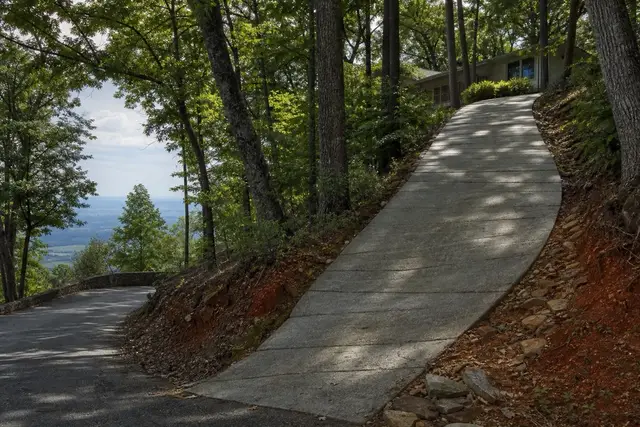
Rocket City Driveways connects Monte Sano homeowners with a local concrete contractor for driveway installation, replacement, and repair across the Monte Sano area.
Monte Sano is Huntsville's mountain neighborhood, spread across the western slopes below a peak that tops out at 1,654 feet — roughly a thousand feet above the valley floor — with the state park at its back. Living on the mountain brings views, big trees, and cooler evenings, and it asks driveways to do things flatland driveways never have to: climb, curve with the terrain, and hold a parked vehicle on grade in the rain.
Slope changes every specification. A mountain-grade drive wants reinforcement sized to the pour, a traction finish — heavy broom texture, or grooving on the steepest runs — and drainage engineered so runoff crosses the drive at controlled points instead of scouring down its full length. Winter raises the stakes further: freeze-thaw cycles hit exposed slopes hard, the average last hard freeze doesn't arrive until March 17, and ice on an untextured grade is a genuine hazard.
Rocket City Driveways connects Monte Sano homeowners with a local concrete contractor experienced in sloped work. A mountain bid addresses anchoring the base on grade, handling the hillside's mix of clay and rock, jointing long inclined runs, and finishing for grip underfoot and under tire. It's more demanding than a flat pour in a subdivision, and it's exactly the kind of job where the right contractor makes the visible difference.
Slope Rewrites the Specification
A driveway on grade is a small piece of hillside engineering. The pour has to anchor its base on slope, hold vehicles at rest without creep, and give tires and shoes something to grip in the rain, which is why steep runs get heavy broom texture or grooving where a flat subdivision drive would get a standard finish. Guidance from the American Concrete Institute underpins the structural choices, from slab design to jointing long inclined panels.
Water is the mountain's other variable. Runoff accelerates downhill, and a drive that lets it travel the full length of the slab will eventually scour edges and undermine the base, so crossings are designed at controlled points instead. Winter sharpens everything: the climate record kept by NWS Huntsville shows freezes arriving well into spring, and an untextured slope with ice on it stops being a driveway at all.
How a Mountain Bid Gets Built
The estimate starts with a walk up the grade. The contractor reads the slope, notes where rock meets clay in the cut, plans how trucks or pumps will reach the pour, and marks where runoff currently crosses. The hillside's blend of clay and rock changes how the base gets built, and the soil education resources published by the Alabama Cooperative Extension System are useful background on why clay behaves so differently wet than dry.
The written bid then covers what flatland bids skip: base anchoring on grade, slab structure matched to the run, joint layout for inclined panels, texture selection for traction, and drainage crossings at set stations. It is more engineering per square foot than any other residential driveway in the county, and it is exactly where a written spec earns its keep.
Good to know
Can a concrete driveway really be poured on a steep Monte Sano grade?
Yes; concrete is the usual choice for steep residential drives because it holds its shape on slope where loose materials migrate. Steeper runs may call for stiffer mixes, placement from the bottom up, and sometimes pumping. The practical limits come down to equipment access and safe working grade, which the site visit establishes.
What finish keeps a sloped driveway from being slick?
A heavy broom texture applied across the direction of travel is the standard, and the steepest sections can be grooved for additional bite. Smooth finishes are ruled out on grade. Texture matters most in rain and during the county's freeze events.
How is ice different for mountain driveways than valley ones?
Exposed slopes shed heat and hold ice longer, and a glazed incline is unusable in a way a flat drive never is. Freeze-thaw cycling also works harder on mountain slabs. Air-entrained concrete, sealed joints, and aggressive texture are the mountain's standard defenses.
How do you stop runoff from washing down the whole driveway?
The design intercepts water at intervals: cross-slopes, channels, or drains that move flow off the slab at chosen points rather than letting it accelerate top to bottom. Edges are graded so water leaves instead of undercutting. On long grades this is the difference between a durable drive and an eroding one.
Does a steep driveway need a stronger slab than a flat one?
Frequently, yes. Slabs on grade carry braking and holding loads that flat drives never see, and stiffer structure helps inclined panels behave as designed. The right spec depends on the slope, the run length, and the ground, which is why it should appear as a line item in the bid.