 Rocket City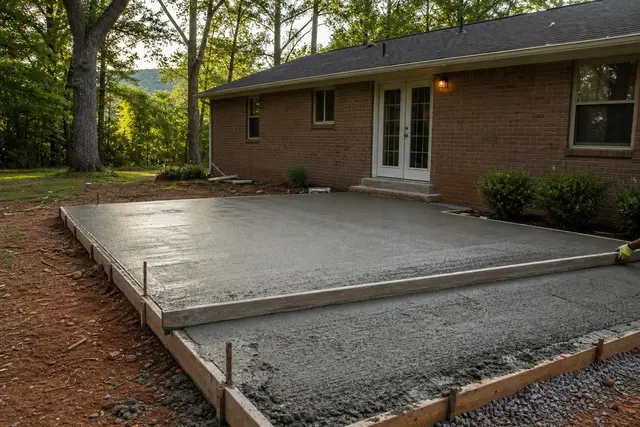
Rocket City Driveways connects Huntsville homeowners with a local concrete contractor for patios & pool decks in Huntsville and the surrounding Madison County communities.
North Alabama rewards a good patio: outdoor weather runs from March past October, and a properly poured slab is the floor for all of it. Patios carry people rather than pickups, so the design attention shifts from load to livability — a layout sized for the furniture you actually own, joints placed as part of the pattern, and slope that quietly steers roof runoff and thunderstorm rain away from the house.
Pool decks add their own rulebook. The surround must drain away from the water on every side, meet coping and equipment pads cleanly, and carry a finish that bare feet can trust when wet — fine broom textures, textured overlays, and lighter colors that stay cooler through an Alabama July all earn their place. And because winter still visits, the same air-entrained mix and sealing discipline as a driveway apply out back.
Patios are also the natural proving ground for decorative work — a stamped pattern, integral color, or an exposed-stone border reads beautifully in a backyard, and on Monte Sano's sloped lots a stepped or terraced pour can turn a hillside into usable space. The contractor your request is matched with can show finish options against a free, itemized quote.
Pouring through an Alabama summer
Summer is patio season for scheduling and the hardest season for the concrete itself. On a July afternoon, surface moisture can evaporate faster than the slab can replace it, inviting the shallow early cracking that hot-weather practice from the American Concrete Institute is written to prevent. The countermeasures are well established: first-light pour times, damp subgrade so the ground does not steal mix water, evaporation retarders in wind, and curing that starts the moment finishing ends.
Local forecasting does real work here. Crews watch NWS Huntsville for the temperature, humidity, and wind combination that dries a surface too fast, and will shift a pour by a day rather than fight conditions. A patio that cures slowly and evenly in its first week is the one that still looks crisp years of summers later.
Building for what comes next
The cheapest time to plan the outdoor kitchen is before the patio exists. Thickened slab zones where a hot tub or masonry island might land, conduit sleeves under the concrete for gas, power, and low-voltage lighting, and separate footings for future pergola or roof posts all cost little at pour time and require saw-cutting later. An hour of what-if conversation during the quote can save a future weekend of demolition.
Where the patio meets the house, the right connection is deliberate separation. An isolation joint at the foundation, a detail consistent with Portland Cement Association guidance, lets the slab move independently of the structure while the surface slopes water steadily away from the wall. Tying the two together rigidly just invites the ground's movement to pick a fight with your foundation.
Good to know
How thick should a concrete patio be?
Four inches over a compacted stone base handles furniture and foot traffic comfortably. Zones intended for a hot tub, masonry kitchen, or other concentrated weight get thickened during the pour.
Does a pool deck need a different concrete mix than a driveway?
It uses the same air-entrained mix, because North Alabama winters visit pool decks too. What changes is the finish: slip-conscious texture, lighter colors that stay cooler, and drainage pitched away from the water on every side.
Why does my concrete patio get so hot in summer?
Dark colors and dense smooth finishes absorb and hold solar heat. Lighter integral colors and textured finishes reflect more and release heat faster, which keeps bare feet noticeably happier in July.
Do I need a permit for a concrete patio in Huntsville?
A flat ground-level slab is often the simple case, but adding roofed structures, kitchens, or anything electrical can change the requirements. The matched contractor confirms what your specific project needs before work begins.
Should a patio be attached to the house foundation?
No, it should be poured against the foundation with an isolation joint between them. That lets the patio move with the soil seasonally without transferring stress into the house.