 Rocket City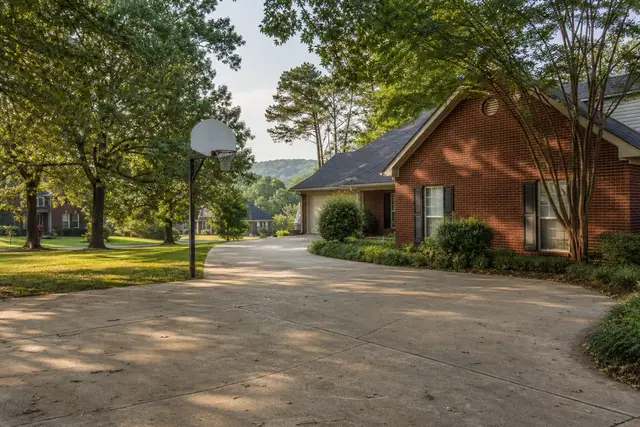
Rocket City Driveways connects Moores Mill homeowners with a local concrete contractor for driveway installation, replacement, and repair across the Moores Mill area.
Moores Mill sits in northern Madison County between Meridianville and the Huntsville city limits, and it reads as the settled middle of the area's growth story — up 18.4 percent from 2010 to 2020 to reach 6,729 residents, with a median age of 41.1 and roughly 55 percent of households headed by married couples. These are streets where people stay put, and that changes what driveway work looks like.
Staying put means the driveway ages alongside the household. Drives poured when a subdivision was new absorb two decades of daily backing and turning, a basketball goal at the edge, and the slow damage this climate deals out: water finding hairline cracks, freezing, expanding, repeating. Some slabs need little more than joints resealed and a settled panel brought back to level; others have cracked through into sections and earn a full tear-out and re-pour.
Rocket City Driveways connects Moores Mill homeowners with a local concrete contractor who can call that repair-or-replace line honestly. Replacement bids account for the red clay subgrade — 35 to 60 percent clay content that shrinks and swells with the seasons — which is why base compaction and control joint layout get specified before anyone talks finish options. The visible concrete is the last part of the job, not the first.
What Twenty Years of Service Looks Like
An established drive keeps a ledger. Hairline map-cracking on the surface is usually cosmetic; a joint that has stopped sealing lets water reach the base; a panel that has dropped half an inch says the ground beneath it moved. The technical vocabulary for all of it lives at concrete.org, but the practical question is simpler: is the damage in the slab, or in what the slab sits on?
On this county's shrink-swell clays, the subject of soil education material from the Alabama Cooperative Extension System, base problems dominate. Resealing joints and patching spalls makes sense while a slab is structurally sound and sitting level. Once cracks run full depth through several panels or settlement keeps returning after repairs, money spent on the surface is money spent twice.
Planning Replacement on a Mature Lot
Tear-out on an older Moores Mill property is choreography around what stays: mature trees whose roots may run beneath the slab, established beds, an irrigation line nobody has a map for. The quote visit flags those constraints first, then sets the rebuild spec: old concrete out, roots handled with the tree's health in mind, fresh compacted base, and a pour with joints placed by plan rather than habit.
Timing leans on the seasons. Freeze-thaw cycling is this climate's slow demolition tool, and climate records from NWS Huntsville are the honest reference for when cold snaps stop being a scheduling risk. A replacement poured in a good window, cured patiently, and jointed correctly resets the clock for the household's next twenty years.
Further reading
Good to know
Should I repair or replace my cracked Moores Mill driveway?
Repair fits when the slab is level and cracks are isolated: reseal joints, fill discrete cracks, patch spalls. Replacement earns its cost when cracking is widespread, panels have settled unevenly, or repairs keep reopening. An honest assessment weighs the slab's remaining life against the repair bill.
How often should a driveway be sealed in North Alabama?
Every few years is the common rhythm, with the exact interval depending on the product used and the slab's exposure. Sealing matters most at joints and cracks, where it blocks the water that feeds freeze-thaw damage. A quick check each fall tells you when the surface has stopped shedding water.
Tree roots are lifting my driveway. Can that be fixed without losing the tree?
Frequently, yes. Options include rerouting the replacement slab, bridging the root zone with extra base and reinforcement, or selective root pruning guided by what the species can tolerate. The wrong move is pouring right back over an active root that will lift the new slab too.
Why do driveways have joints, and how far apart should they be?
Concrete shrinks as it cures and moves with temperature, so it will crack; joints decide where. For a typical four-inch driveway, control joints go in at intervals around ten feet, cut to about a quarter of the slab's depth. Joints cut late or spaced too far apart are why random cracks appear.
What does freeze-thaw actually do to a driveway here?
North Alabama winters cross the freezing line repeatedly rather than staying cold, and each crossing freezes water inside cracks and pores, where it expands roughly nine percent. That pressure widens cracks and flakes surfaces season after season. Air-entrained concrete and sealed joints are the standard defenses.