 Rocket City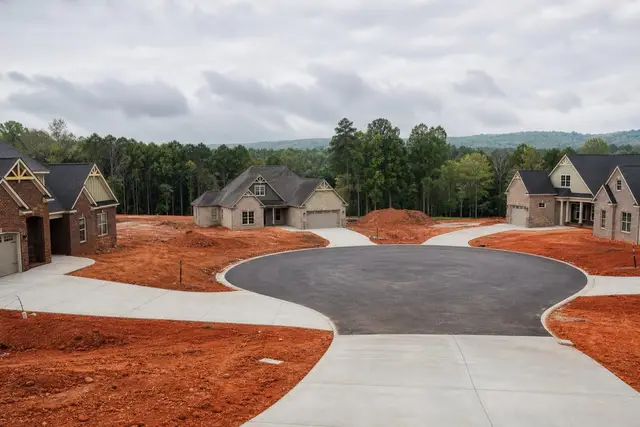
Rocket City Driveways connects Harvest homeowners with a local concrete contractor for driveway installation, replacement, and repair across the Harvest area.
Harvest changed gears in 2021, when the Mazda-Toyota plant opened nearby and brought roughly 4,000 jobs to northwest Madison County. The community had already grown 11.6 percent between 2010 and 2020 to reach 5,893 residents, estimates put it near 6,934 by 2024, and the acceleration is visible from the road — graded pads, framing crews, and new subdivision entrances standing where cotton grew only a few years ago.
New-subdivision territory produces a particular mix of concrete work. Buyers add what builders left out: a wider approach so two cars can pass, a pad behind the fence for the boat, a walkway that doesn't cut a path through the grass. And because lots here were shaped fast during the building boom, the ground under some drives received less compaction than it needed — the kind of shortcut that shows up as a dropped slab corner two summers later.
When Rocket City Driveways connects Harvest homeowners with a local concrete contractor, the conversation starts with the subgrade. North Alabama winters swing above and below freezing repeatedly rather than staying cold, and every swing works water deeper into the clay beneath a slab. Proper base rock, positive drainage away from the pour, and joints that give cracking a planned place to happen are what let a Harvest driveway ride out those cycles.
Fast-Built Lots and What They Hide
When a subdivision rises quickly, earthwork happens at production tempo. Pads get cut and filled to hit schedules, and the compaction under a garage slab usually gets checked more carefully than the compaction under the driveway beside it. Two or three summers later, a dipped corner or a stair-step crack announces where the shortcut was.
Regional context helps explain the pace: the workforce arriving for northwest Madison County's manufacturing jobs keeps framing schedules full, growth of a scale visible in the Census QuickFacts profile for the wider Huntsville area. New buyers then add the approach widening, the boat pad, and the walkway the builder never priced, and each of those additions deserves better ground than the original pour got.
From Walkthrough to Pour on a Harvest Lot
Scoping starts with the subgrade. A contractor checks how the lot was shaped, identifies fill zones, and specifies compacted crushed stone deep enough to bridge the soft spots. Material from the Alabama Cooperative Extension System on clay soils makes the stakes plain: this ground moves with moisture, and the base is what isolates a slab from that movement.
The visit also settles drainage and sequence. Flat new lots need a deliberate two percent fall so storm runoff leaves the slab instead of soaking its edges, a concern the EPA's stormwater resources address at development scale and a driveway repeats in miniature. A typical project then runs a few days: tear-out or forming first, base placement and compaction, the pour itself with joints cut within hours of finishing, then a cure period before the first car rolls on.
Further reading
Good to know
Should I wait for my new Harvest lot to settle before adding a driveway extension?
Time alone does not fix poor compaction, and loose fill can keep consolidating for years. What matters is that new work sits on mechanically compacted base rather than on whatever the graders left behind. A contractor can evaluate the ground now instead of waiting on it.
Does a concrete driveway really need a gravel base in Harvest?
On this county's clay, yes. A compacted crushed-stone layer spreads vehicle loads, drains water away from the slab's underside, and buffers the shrink-swell movement of the clay beneath. Pouring directly on clay is the most common origin of early cracking.
How long does driveway installation take in Harvest, AL?
Demolition, forms, and base compaction commonly fill the first day or two, the concrete goes down in a single day after that, and curing starts the moment the finish is done. Plan on keeping vehicles off the new slab for around a week. Weather can stretch the schedule, since pours wait for workable conditions.
How should a driveway drain on a flat Harvest lot?
Even flat-looking slabs are built with roughly a two percent slope so water sheds toward the street or a swale rather than standing. Downspouts should discharge away from the slab, never across or under it. Standing water is a base-killer on clay ground.
Will an added strip of concrete match my existing driveway?
Expect a visible difference at first, since fresh concrete starts lighter and weathers gradually toward the original without ever promising a perfect match. Consistent finish texture and clean saw-cut seams do more for appearance than chasing color. Some homeowners lean into the contrast with a border detail.