 Rocket City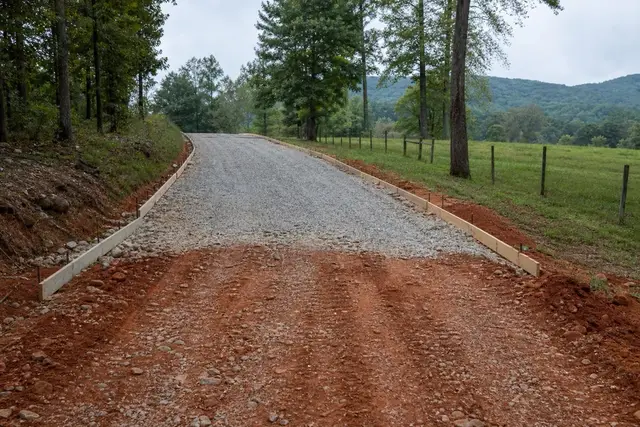
Rocket City Driveways connects Huntsville homeowners with a local concrete contractor for gravel-to-concrete conversions in Huntsville and the surrounding Madison County communities.
Gravel drives are everywhere on the edges of Madison County, and the Tennessee Valley's iron-red clay makes short work of them. Heavy rain floats the fines away, tires press ruts into the softened subgrade, and by February the driveway is two muddy tracks and a delivery-truck hazard. Fast-growing outlying communities — Triana among them, after a decade of explosive homebuilding — are full of properties ready to make the switch.
The good news is that an old gravel drive is a partial down payment on a concrete one. Years of traffic have compacted the stone into the clay, so conversion often means reshaping and topping up that base rather than starting from bare earth. What always gets engineered fresh is drainage: gravel drinks a storm while concrete sheds it, so crown, side slopes, and culverts have to carry the runoff somewhere deliberate.
The pour itself is a standard reinforced slab on the rebuilt base, using an air-entrained mix for North Alabama winters and jointed to suit the long runs common on rural lots. Longer drives can be built in stages — apron and parking court first, the back stretch later — and the free quote from your matched contractor breaks the phases out so you can budget it that way.
Sizing up the site before any concrete moves
A conversion starts with an honest read of the ground. The Alabama Cooperative Extension System documents how the region's clay soils lose bearing strength when saturated, so the contractor probes for soft spots, watches how the drive behaves under a loaded truck, and marks utilities before a single yard of stone is moved. Sections that pump or rut under weight get dug out and rebuilt rather than paved over and inherited.
The other checkpoint is the culvert. Most rural drives cross a road ditch through a pipe that has spent decades collecting silt or slowly crushing under traffic, and paving over a failing culvert guarantees a repair that requires cutting brand-new concrete. Stormwater principles the EPA promotes apply in miniature here: the ditch, the pipe, and the new slab's crown all have to move the same storm in the same direction.
Pour-day logistics on a long rural drive
Long country drives get poured on the calendar's terms. The clay subgrade needs to be workably dry, which favors late spring through fall, and a several-hundred-foot run means multiple ready-mix trucks sequenced so fresh loads always meet workable concrete rather than a cold joint. Where the trucks cannot chute directly, a pump or buggy bridges the gap without tearing up the yard.
Then comes the only hard part for the household: staying off it. A conversion usually means the driveway is the only route in, so the week of cure takes planning, whether that is parking at the road, coordinating deliveries, or phasing the pour so one half stays drivable. It is a solvable problem, but it is solved before pour day, not during. The outside reference used for this Huntsville planning point is National Ready Mixed Concrete Association.
Further reading
Good to know
Can concrete be poured directly over my existing gravel driveway?
Often the old gravel becomes part of the new base, since years of traffic have compacted it into the clay. It still gets regraded, topped up with fresh stone, and re-compacted; loose or mud-contaminated sections are reworked rather than trusted.
How much does converting a gravel driveway to concrete cost?
It varies more than most projects because length, base condition, drainage, and culvert work all swing the number. The matched contractor returns a free itemized quote, and long drives can be broken into phases to spread the budget.
Do I need my culvert replaced when the driveway is paved?
Only if it is crushed, rusted through, or undersized for the ditch it serves, which the site evaluation checks. Sorting the culvert before the pour avoids ever having to saw through new concrete to reach it.
What time of year is best for a gravel-to-concrete conversion?
Late spring through fall, when the clay subgrade is dry enough to compact properly. Winter conversions are possible but wet-season ground conditions can stall the base work.
Will paving the driveway finally stop the mud and dust?
On the drive itself, completely, since concrete sheds water instead of churning into ruts. Good edge grading finishes the job by keeping clay from washing across the new slab in heavy rain.